Story file
Fusion Markets vs Tickmill: The All-In Cost, Priced to the Pip
Two low-cost schedules converted into the only unit that permits comparison — pips per standard lot, round turn. One raw account prices at 0.45 before spread, the other at 0.60, and neither figure is an average.
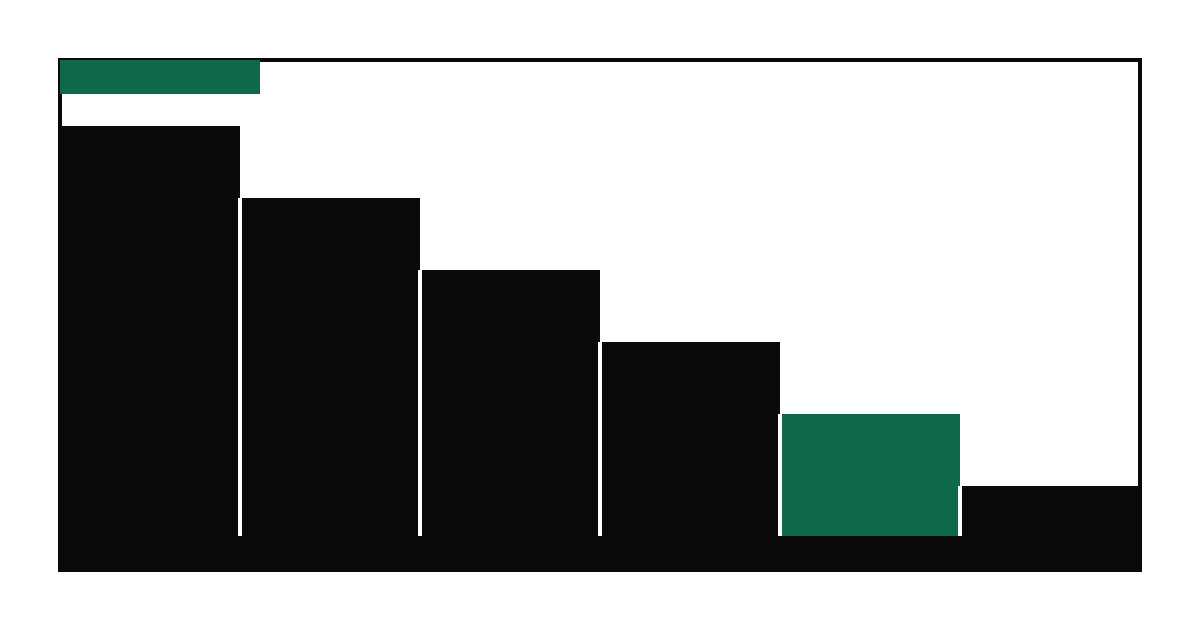
Two low-cost brokers side by side, and the first problem is not which is cheaper: they quote in different currencies of persuasion, dollars per side here, pips there. Until both sit in one unit — pips per standard lot, round turn — there is no comparison, only two advertisements filed together.
What each side actually publishes
Tickmill’s accounts page lists three retail account types, one cost line each. Fusion splits the same material between an overview and a Zero account page.
The conversion
One standard lot of EUR/USD is 100,000 euros, and one pip on it is worth roughly ten US dollars. Commission per side, doubled, divided by ten, is commission expressed in pips. That step is the whole method, and neither firm takes it for the reader.
Fusion’s Zero account: $2.25 doubled is $4.50 per round turn, or 0.45 pips. Against a published floor of 0.0, the all-in floor is 0.45. Tickmill’s Raw account: $3 doubled is $6, or 0.60 pips, on the same 0.0 floor. The gap is 0.15 pips — $1.50 per standard lot.
On the commission-free accounts one side shows its working. Fusion’s FAQ states that the Classic price is the Zero spread plus 0.9 pips, putting its floor at 0.9; Tickmill publishes its Classic floor as 1.6 with no commission. Seven tenths of a pip, or $7 per lot, for the convenience of not multiplying anything.
Tickmill’s TradingView Raw line converts to 0.70 pips, making that platform a published surcharge of 0.10 pips over the firm’s own MetaTrader Raw account — a dollar per lot, printed rather than buried.
Two hedges: the ten-dollar pip value holds for USD-quoted majors at 100,000 units, and other pairs or base currencies move it. Every figure above is a floor.
What a floor does not tell you
“From 0.0” is the least informative statistic a spread distribution can produce, and invariably the one set in the largest type — a complaint this desk has filed at length. Fusion’s FAQ puts the Zero account’s total cost at approximately 0.5 pips and the Classic at around 0.9: estimates, not averages. One real average does surface: the same FAQ gives EUR/USD on the Classic at 0.92 including commissions, the only instrument-level figure either firm commits to in writing. Everything else moves. Fusion’s live spread page carries third-party data it states is drawn from the Zero account, updated hourly and marked indicative only; Tickmill loads its minimum and typical columns client-side. Neither leaves a table a reader can save.
Who signs the agreement
Cost is one column; the counterparty is the other. Tickmill’s licences page lists its group entities with numbers: Tickmill Ltd in the Seychelles under FSA licence SD008, Tickmill UK Ltd with FCA register number 717270, Tickmill Europe Ltd under CySEC 278/15, and Tickmill South Africa (Pty) Ltd under FSP 49464. One of those is checkable against a regulator rather than a broker: CySEC’s public list of Cypriot investment firms carries Tickmill Europe Ltd at 278/15, dated 5 August 2015, as of this writing. The rest is the group’s own account of itself. Fusion’s footer names three licence-holding companies: Gleneagle Securities Pty Limited, trading as Fusion Markets EN, a Vanuatu company numbered 40256; Fusion Markets International Ltd, a Seychelles securities dealer, licence SD096; and, for Australian clients only, FMGP Trading Group Pty Ltd under AFSL 385620.
Read the leverage line beside that. Tickmill’s global accounts page prints a maximum of 1:1000 — an offshore-company figure, not a UK or Cyprus one, where retail leverage on majors is capped far lower. Leverage that size is not a feature to shop for; it is the rate at which an account can be emptied. Fusion lists no UK or EU entity at all.
Bottom line
On published figures the arithmetic is not close: Fusion prices lower on both account types, by 0.15 pips on raw and 0.7 at the commission-free floor. On who holds the account it runs the other way — Tickmill’s group contains UK and Cypriot companies, Fusion’s none. Opposite directions is the honest result, not an evasion.
A floor is a marketing number; an average is an accounting one. Until either firm prints the second by instrument over a stated period, the reader supplies the column that decides the answer — and the company that would answer in writing is the one whose name sits at the foot of the client agreement, which residence decides. Every figure above is published by Fusion Markets or Tickmill and converted here, none of it measured on this desk. Fuller audit of the raw-pricing model: IC Markets, reviewed.
The subtraction this desk prints last: leverage magnifies a loss as efficiently as it magnifies a position, a cheap schedule is not a protection, and nothing in this comparison is financial advice.